Monday, December 31, 2007

Pictures of the Yacht Race

When I wrote about our yacht race, I didn't yet have any pictures available. So enjoy!


On Learn to Sail Day, everybody got a chance to steer the Amulet and learn how to winch the sail sheets and halyards.


The following week we raced. You can see us in front of a charging stampede of sail boats, having just rounded the first marker.


Early on, despite some intense winching, we were able to frolic with one of our neighbours. It was nice to listen to live fiddle music while we raced by this boat.

Some advantage was to be had by holding out the jib sail. The task was shared by Nancy and I. Somebody said something funny and I stuck my tongue out.

The eventual winner of the race, the catamaran to our right, was unbeatable with its professional crew and lighter frame.


Here you see me winching furiously with Ali tailing the line behind me. The faster we winch, the more quickly we can tack the sail and re-gain speed.


Here's our race crew that evening at the Marshall Islands Resort for the after-race party. From left to right: Ali, me, Valerie, Darren, Nancy and Chris (skipper).

Tuesday, December 18, 2007

The Big Race

“Pull pull pull! Come on!!” came the almost angry yell from the wheel. In spite of borrowed gloves, my hands were raw and my arms exhausted. I heaved on the sheet line once more and wrapped it. Time was of the essence, we were losing wind power. I clamped on the handle and started cranking. Much slower than pulling by hand, the jib sail slowly unfurled and we began to gain speed.

The boat was tilted to the left so I was having trouble balancing and winching at the same time. I wedged my bare foot on a hard place to regain my balance and resumed winching as hard as I could.

After tacking our sails we had a moment to rest and strategize the next move. The race was going well. Only a catamaran with a professional crew was ahead. But in sailing, as in golf, there’s a handicap applied to you depending on your boat. So we’d need to beat certain of the boats trailing us by a significant margin (one by as much as 7 minutes) to hold 2nd place.

But by the time it was clear that no one else would catch us, I was handed the tiller. I now had rudimentary understanding about keeping the main sail most efficiently in the wind. It was sunny and breezy; perfect weather! I was incredibly focused. The boat needed constant course corrections to stay on target, but I still took moments to just look around and feel the sun.

The skipper eventually wanted the tiller back and we had to make two more tacks. We were exhausted but the finishing line was minutes away. Pulling hard, this time I furled the jib sail so that it could be shifted. When it was three-quarters furled, a crew mate began to furiously unfurl on the other side of the boat, so that it could get back into the wind. We managed to do it and then back again right at the end (and just in time to avoid hitting a Chinese fishing boat).

We ended up finishing 2nd. Hurray!

A rum drink was never quite so appreciated as after we moored the Amulet. It was a gruelling 2 hour long 11 mile course to one end of the lagoon and back. It was a fantastic day.

The Wacky Election List

This election (and its aftermath) gets wackier and wackier all the time. Here are some of my favourite moments:

1. On voting day, folks that voted had their finger dipped in a super-enduring black ink in order to prevent people from voting at more than one location. A good idea in principle, but the ink remained on people’s fingers in spite of washing for four more days.

2. Confusion at the Majuro Airport voting station led officials to require people to write their names on ballots, assuring a fair and anonymous vote.

3. Merely days after the vote, the AKA Party changed its name to UPP. (Presumably this would indicate a change in platform of some kind, as some senators switched parties in the process, but since there are no platforms, the purpose of the name change appears to be aesthetic.)

4. Mr. Tomeing, Speaker of the House, switched parties (to the opposition) and declared a One China policy (contradicting his own former government’s policy to recognize Taiwan). In so doing, he failed to remember to return the expensive solar panel equipment Taiwan donated in order to electrify his home atoll of Wotje.

5. The Constitution indicates that voting will be held on Monday. However, because voting booths started late and were so incompetently run, some people waited in line for up to 12 hours, forcing them to vote in the early hours of Tuesday. Some are advocating that these votes be discarded because they occurred in an illegal manner.


If I waited in line for 12 hours and then my vote didn’t count, I would have words with the person responsible for that.

Monday, December 10, 2007

Skipper at the Tiller

On Sunday morning a bedraggled bunch made their way into a meeting hall near the Shoreline Dock. The MIECO Yacht Club, of which Ali and I are members, was holding Learn to Sail Day, an opportunity for land-lubbers to learn how a sail boat ticks. The morning was like a class: handouts to study, chalkboard diagrams of the parts of a sail boat and even a test – can you tack a sail sheet?

One thing that is now clear is that there is no rope on a sail boat. What? There seem to be hundreds of ropes: to hoist and tack the sail, moor the boat, drop the anchor, etc. But no, there are no ropes on a sail boat. It’s called a rope when you buy it in the store, but the name magically changes to the likes of halyard or sheet… or line. Call it a rope and risk being laughed at, or worse, thrown overboard for your idiocy.

After lunch we left the classroom and got to actually sail boats. The sailboat owners, many of whom live on their boats, invited us on to take a ride. It was with great satisfaction that six of us volunteers climbed out of a dingy and onto the deck of The Amulet. We removed our flip flops – barefoot only! – and were given a little tour.

Our hosts were a really nice American couple that quit their engineering jobs in 1998 to sail around the world. They’ve been to 42 countries so far, including most of Europe, the Caribbean and the Pacific islands. They’re both hands-on, so they can repair the engine themselves and are pretty close to self-sufficient.

As we got underway I helped raise the main sail and unfurl the jib sails (smaller ones at the front). It was hard work. Everything was manual. Tightening could be done with a crank (which, like everything, had a special name, but I forget). Otherwise it’s about muscle power. Speaking of the ‘crank’, we were informed of the 2-splash rule. There are two of them and they each cost $100. If the skipper hears one splash, because the crank was dropped, he better hear another splash – to signify the sailor retrieving it.

We sailed around half of the atoll and turned around to return to port. Each of us got to steer the tiller. It wasn’t my first time steering a boat by any means, but manning a boat powered by wind is different! A sandbar was approaching and our GPS said we had to sail at more than 121 degrees from the shoreline to avoid it. (Ok, so some technology is useful!) I altered course and successfully avoided crashing the boat.

After we moored we shared some drinks and continued to get to know each other. We ended the evening with plans for next weekend. This Sunday there’ll be a big yacht race. So on Saturday we’ll be practicing tacking and jibing manoeuvres to get ready.

Monday, December 3, 2007

Extracurricular in Particular

Outside of work and snorkelling, I’m involved in a bunch of activities. Every Monday and Wednesday I play soccer or go to an aerobics class. Every so often some of the guys get together for Man Night, at which drinking, belching and poker go hand in hand. But the following activities are things I could only do here in Majuro.

Tutoring at WAM

WAM is a fantastic NGO that takes troubled older youth off the street and puts them through a 6 month carpentry course in which they work together to build the traditional outrigger canoes. On Thursdays at 4pm some of the World Teach volunteers and I tutor them in English. It’s a great chance for me to get out of the Ministry of Education to actually educate.


Scuba Diving Lessons

I’m reading a manual right now, but I’ll soon wet my feet with a scuba tank on my back. I’m excited to get going on this because once I’m certified I’ll be able to dive anywhere in the world. And what could possibly beat a coral atoll to scuba dive?

The Majuro Writers Guild

We don’t smoke pipes or wear tweed jackets, but once a month some friends, Ali and I exchange writing and read to each other. It’s a fun chance to get an audience for what I’m writing and also get valuable criticism. Wine and cheese are mandatory.

The Yacht Club

Starting next Sunday, Ali and I will be learning to sail. I’m really excited. The Majuro Yacht Club consists of a bunch of sailboat owners and locals like us that team up to race the yachts once a month. I’ll write more about that later since we’re just about to start next weekend.

Wednesday, November 28, 2007

Covering an election from afar

On November 17th I flew to San Francisco to conduct “research” for my Masters Paper. As far as the U.S. government is concerned, I don’t belong in the Marshall Islands while I’m on a U.S. Student visa. So I had to set foot on mainland USA in order to keep my visa active.

I necessarily needed to be outside of the Marshall Islands at a crucial moment in history: the November 19th national election. This was too bad but I decided to make the best of it. I was going to interview a couple of people about the Marshallese election. Here are some sample questions I wanted to ask:

Who do you expect to become Prime Minister? (trick question to demonstrate ignorance, since the Marshall Islands has a President)

If you were an election observer, would you use a clipboard or a note pad?

Suffice to say, all I might get is an unscientific sampling of whether people prefer clipboards or note pads. In my busy schedule (I slept in a lot), I didn’t get around to the interviews.

To get an inside view of Decision 2007, see Senior Political Correspondant Alison Lemoine’s blog.


So now I’m back in the Marshalls and will not let my blog slip for 2 weeks again!

I’d like to leave you all with the youngest candidate to run for the senate:


Friday, November 16, 2007

22 on the swell

Ali and I joined Youth to Youth in Health on a day-long trip to the Arno Atoll. We took the XXXX (named after an Australian beer) across an hour of rough open ocean. It was against the current, so the boat rocked up and down and side to side pretty significantly. I'm proud to say I didn't throw up (neither did Ali!), but I came pretty damn close. By the time we arrived, my legs and arms got tingly, I felt dizzy and a definite urge to hurl.

We rested for a bit and after recovering we went to a nearby elementary school to put on some songs and teach the young'ins about sex. We separated the boys from girls. Then the boys got a condom demonstration (some were a little to young to understand what was going on, but exposure is good!). The girls were taught about the reproductive system. Ali will write more about that (http://alisonlemoine.wordpress.com).

Then we took a a bumpy ride in the back of a flat bed truck to another school. It took about an hour to get there and it rained heavily during the trip. It was undoubtedly (in addition to the boat ride) the most uncomfortably day of my life so far! But boy was it worth it. Ali and I got to sing with the kids at 2 schools on Arno and were amazed by the atoll's beauty.

Majuro, as I've mentioned, is a really over-populated slum. There's trash everywhere in the downtown area. Arno, on the other hand, must have about 500 people occupying the same area... maybe a bit smaller. The beaches are pristine! Unfortunately, we didn't have time to really swim. So Ali and I are planning to bring my mom there in January for a long weekend.

I'm off to San Francisco to cover the Marshallese election. Since no foreign correspondants seem to be coming here to find out how well the election goes, we're sending someone abroad to get a man on the street perspective. So I volunteered to go to San Francisco for just that reason.

Just kidding. I'm actually going to San Francisco to fulfill my student visa requirement. But I will write about the election in my next entry.

Cheers,
Steve

Friday, November 9, 2007

How many angels fit on a pinhead?

"In 2007, for the first time in history, the majority of
people will live in urban areas. Throughout most of
the developing world, this will result in larger slum
populations."

-Millennium Development Goals Report 2006


What do you picture when you think of a slum?

Have you ever been in one?

During the industrial era, London could apparently be smelled from miles out. It was the first city in the world to hit a million inhabitants, but did so well before it installed plumbing. Urine, feces, and the stink of human beings without water to wash polluted the air as surely as the coal factories.

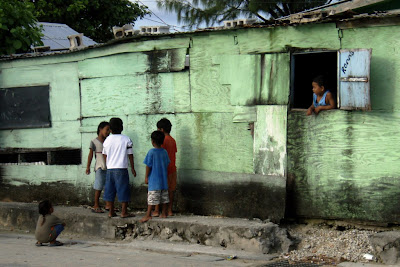
I live next to a slum called Demon Town. Cement houses with corrugated tin roofing co-exist one next to the other. Between them are spaces occupied by the occasional pandanus tree or plastic chair. The houses are clearly in need of repair. The roofs are rusting and the cement walls chipped. The ones that are painted formerly bright colours fade in the hot sun and peel in the humid salty air. Most of these houses are off the grid and lack plumbing. So most people have to do their business out on the reef.

What strikes me more than this, however, is the severe congestion of people within these conditions. When I walk down the side street running through Demon Town at 5 P.M., hundreds upon hundreds of kids are milling about, doing what kids do. Older teenagers and adults sit around and bwebwenato, conversing about anything from the upcoming election to who’s sleeping with who.

The Marshall Islands may be a tropical Pacific nation, but it’s not paradise. I’m told that many of the outer islands are paradise. But almost 70% of the population lives on either Majuro or Ebeye. Where does that put the Marshall Islands on the urbanization scale?

Really high.

Ebeye in particular is home to 10,900 people on only 0.14 square miles of land. That’s a population density of 66,750 persons per square mile. This density level rivals any place on Earth. It’s important to realize that people live in 1 or at most 2 storey level buildings (with the majority in 1 storey buildings).

Therefore, go to your living room. Now imagine no furniture. Now imagine 12 people sleeping in this space. Medieval theologians debated how many angels could fit on the head of a pin. A more useful question would be: How many people can you cram together in a small room?

43% of the population is under 14. The Ministry of Education faces a huge challenge to get all these kids in school, not least because there’s so little land available for school expansion. I jokingly proposed in my last blog entry that the Marshall Islands could import garbage to cope with global warming. But the idea was actually discussed by the Nitijela (senate) – land reclamation is huge priority here.

I mentioned that when I walk through Demon Town at 5 P.M. there are more kids than I can count. But if I walk through at 10 A.M. there are still a few walking around. I know they’re not in school because they’re dirty and don’t have uniforms on.


It gets worse. With a limited number of spaces available at the high school, only the top ranked students get in. The rest are left with few job prospects. This leads to drinking, drug abuse and hopelessness.

My favourite sociologist, Émile Durkheim, coined the term anomie to describe the sense of loss and depression that people have when they lose their roots in an impersonal urban environment. It’s an ironic idea – that at the same time that you’re more surrounded by people than ever – you feel more alone. So it’s not altogether surprising that Durkheim wrote a book called
Suicide.

A 2003 study by UNICEF found that in the Marshall Islands: “Suicide is the leading cause of death among people aged 15-44 years of age, and until recently occurred almost exclusively among men”.


Had enough? I hope I haven’t depressed you too much before the weekend. Lest you think I’m in a funk, you should know that I thrive on this stuff. Nothing is more fulfilling than knowing that I get to work on people’s problems and contribute, even if just a little, towards improvement.

Not enough kids going to school?

Fine.

What can I do about it?

I’m a glass is half full kind of guy – an optimist.

What’s the point of being anything else?

Friday, November 2, 2007

The highest point in the country

Atoll nations consist of tiny parcels of land surrounded by millions of square miles of ocean, but that’s not what really scares me. What is scary is that atolls are quite flat by nature. The highest point in this country is a bridge (pictured below) which connects two parts of the Majuro island. I’ve jumped off higher places into water. It’s only about 20ft high, if that - and it’s a significant rise over the rest of the land. That’s to say that if the ocean were to rise by only a few feet, most of the land in the Marshall Islands would be under water.


Now why would that happen?

Well, if what Al Gore says is true (and you must watch his documentary,
An Inconvenient Truth), then this scenario is quite plausible. Large pieces of ice are melting at both poles.

Surely people have the power to reverse this trend of global warming, but people change their ways at the pace of snails. And too many corporations stand to pay a lot of money to update their factories to cleaner technologies. So the American, Canadian, Russian and Chinese governments resist implementing the Kyoto agreement, which frankly, is only a small first step in the endeavour to reverse warming.

Call me pessimist, but my bet is that the Marshallese people will be looking for new homes in the next 20 – 50 years.

It made me wonder whether the national government here has some kind of evacuation plan in the works.

It doesn’t.

20 years is an unfathomable time to a politician.

Luckily, only 50,000 people live in the Marshalls. And we won’t have to evacuate everyone right away. (So if you pictured hundreds of boats and helicopters in a convoy, you’ve watched too many movies.)

Here’s my prediction:

Over the next decades, the water will slowly rise. Land, which is already at a premium, will further increase in value (and so housing costs will rise). This will drive some people to leave the country to find places where they can drop less of their earnings into rent. So the population of people that can afford air fares will decrease.

But since the poorer people still aren’t using birth control, the proportion of people that can’t afford a plane ticket is increasing.

In addition, the Marshallese are woefully under-educated, so even those that do leave usually work at the bottom of the totem pole. In the U.S., the largest contingent of Marshallese people work at a Tyson Turkey processing plant. Others pump gas. Many are simply unemployed.

But for those that can’t afford to leave on their own, I propose 2 potential solutions:

Plan A: Recycle Offshore Drilling Platforms

Ironically enough, the very source of our global warming woes can be put to work: our dependency on fossil fuels. In a public relations project of epic proportions, the various oil giants can donate old offshore drilling platforms to the atolls. By 2020, history will be made by the first countries ever to live on completely artificial territory.

Plan B: Import Trash from America

Survival or economic good sense? The Marshall Islands can become the world’s most significant importer of trash. Most of Boston is a trash-heap-cum-city, so why not Majuro? A few hundred feet of garbage can be laid on top of the coral foundation. We can certainly count on Americans to produce enough trash to out-pace global warming! Not only trash importers would benefit from this economic boom. Tourism would get a boost as beautiful grass-coloured hills could form the back-drops for exotic golf courses and sight-seeing tours; nose-plugs included. Coke Tower (made of recycled cans and bottles) will be the tallest building in the Pacific region.

I will submit my draft proposals to the Ministry of Interior with hopes of getting a fat consulting fee to implement Plan A or B.


But seriously, my evacuation plan would focus on education. Getting people off a sinking ship is a logistical problem, yes, but even if we do get people off the islands, the next generation of Marshallese may end up a poor under-class living in the United States. We gotta get these kids some skills.

Tuesday, October 30, 2007

Phrases you won't see in a tourism brochure

Fly dependable Air Marshall Islands.
In-flight, we'll provide you with a handy map of underwater delights,
including planes less lucky than your own!


When you arrive, take a boat excursion to Anemanit island.
Moor at the unfinished jetty.


Lose $50 at the crab fights.

Catch your own breakfast.
Moray eel anyone?

Enjoy exotic fauna.
------
Note: No moray eels were eaten in the making of this tourist brochure.
P.S. My good buddy Jim (above) was completely non-plussed by the exotic fauna at Anemanit.